
There are moments in the long, fractured story of a nation when history ceases to move at the measured pace of time and begins to gallop.
In such rare seasons, events do not merely unfold; they converge. Personalities, purpose, and providence meet at a single crossroads, transforming governance into something that feels almost fated.
Nigeria, a country whose journey has been etched with paradoxes, bruised by squandered possibilities, yet sustained by an unyielding faith in tomorrow, now appears to stand upon one of those defining thresholds.
It is the kind of moment when the past loosens its grip, the future gathers its breath, and the present demands uncommon leadership.
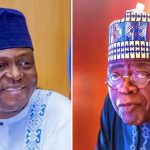
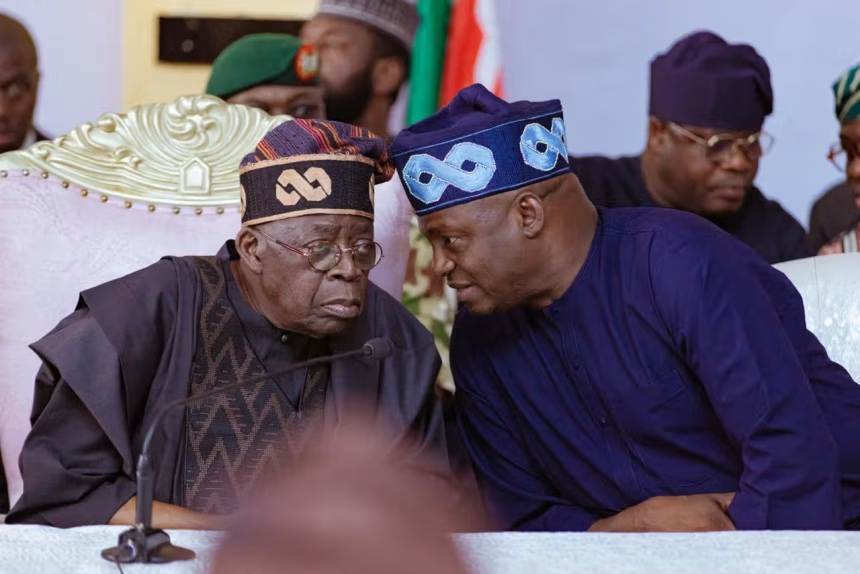
At the heart of this unfolding narrative stand two men whose partnership has become a compelling study in vision and resolve: President Bola Ahmed Tinubu, the navigator at the helm of the Federal Republic, and Professor Nentawe Goshwe Yilwatda, the cerebral, methodical, and indefatigable National Chairman of the All Progressives Congress.
More Read
One steers the ship of state; the other fortifies the political architecture that sustains its voyage. Their strengths are distinct, yet remarkably complementary.
Together, they aspire to do more than administer the machinery of government. They seek to recalibrate its moral compass, restore confidence in its institutions, and breathe renewed purpose into the promise of the Nigerian state.
History will ultimately vindicate their enterprise. They have placed before the nation an ambitious vision whose measure will be taken not merely by rhetoric, but by the enduring imprint of its outcomes.
Their story is, in many ways, the story of two torches kindling a single flame – two minds, two mandates, one horizon.
It is a portrait of leadership forged not in uniformity but in convergence, where conviction meets competence, and where the light of shared purpose dares to illumine the path of a nation still searching for its finest dawn.
To understand what is happening, we must first resist the instinct to dismiss it. Nigerians have every reason to be cautious.
New possibilities
We have lived through too many broken promises, too many years of poor leadership, deep ethnic divisions, and the painful contradiction of a nation blessed with immense resources yet held back by weak institutions.
That experience has made scepticism almost second nature. It is understandable. It is even healthy.
But scepticism should never become a prison. Every nation reaches defining moments when the impossible begins to look achievable, when old patterns give way to new possibilities.
The evidence, and this commentary is grounded in that evidence, suggests that what Tinubu and Nentawe are building together deserves to be judged on its substance, not on the disappointments of the past.
This is not another political mirage. It is the careful laying of foundations for a different kind of Nigeria, one built on reform, innovation, and the confidence that lasting transformation is possible.
Tinubu’s unyielding vision
Let us begin where authority begins: with the president of the Federal Republic. Tinubu did not stumble into Aso Rock. He engineered his arrival across thirty years of political combat, electoral setback, alliance-building, and ideological consistency that his detractors have never adequately reckoned with.
The very qualities they once weaponised against him, his tenacity, his network-building, his refusal to accept political exile as permanent, turned out to be precisely the qualities Nigeria needed at this hour.
A man who has been knocked down and found his feet again carries a different kind of authority. He governs not just with the confidence of the elected, but with the hard-won wisdom of the survivor.
Good bye to old ways
From his first day in office, Tinubu signalled that his administration would not be a continuation of the timid politics of managed decline.
The removal of the fuel subsidy, announced with brutal efficiency on the very day of his inauguration, was either the bravest or the most daring economic decision a Nigerian president had made in decades depending on who you asked, and more importantly, on how the subsequent management of that disruption played out.
What became undeniable was that Tinubu understood something his predecessors had refused to confront: that Nigeria could not continue to borrow money from tomorrow to subsidise the consumption of today.
The subsidy was not protecting the poor. It was protecting the powerful, the petroleum cabal, the arbitrageurs who smuggled subsidised fuel across borders while ordinary Nigerians queued for hours to buy it at stations that often had none.
Beyond politics
The pain that followed the removal was real. No honest analyst can pretend otherwise. Inflation bit hard. Transportation costs surged. Families recalibrated their budgets in real time.
But pain, in economics as in surgery, is not always a sign that something has gone wrong. Sometimes it is the price of something going right.
Tinubu understood this, and rather than reverting under political pressure, his administration began deploying palliative structures, cash transfers, student loan schemes, CNG bus rollouts, and other buffers designed to absorb the immediate shock while structural reform did its slower, more durable work.
This is the hallmark of a leader who thinks in economic frameworks rather than electoral cycles.
Tinubu is not governing for the next election; he is governing for the next generation. There is a difference, and Nigeria has not had enough leaders with the courage to inhabit it.
His economic philosophy is not difficult to read for those who pay attention. It is rooted in the Lagos model, the proof-of-concept he built across his years as governor of Lagos State. When Tinubu came to Lagos, the state was broken.
Its internally generated revenue was barely functional, its infrastructure crumbling, its governance architecture a monument to stagnation.
When he left, Lagos was generating the kind of internal revenue that small African nations envied. The lesson he took from Lagos was not that government spending is the answer.
At the heart of every functioning state lies government capacity: the ability to collect, deploy, and account for resources. Without it, little else is possible. A government that cannot tax cannot serve. A state that cannot collect cannot build.
That principle now animates his federal strategy.
Reform
The on-going reforms in the tax administration system, the push to broaden Nigeria’s revenue base beyond petroleum, the engagement with foreign direct investment through strategic diplomatic travel, the deliberate signalling to global capital that Nigeria is open for business under conditions of greater predictability, and these are all expressions of the Lagos mind applied to the national canvas. The scale is different.
The complexity is greater by orders of magnitude.But the logic is the same: get the fundamentals right, and everything else becomes possible.
None of this is to say the administration has been without stumbles. Tinubu has had to navigate the treacherous terrain of elite politics, managing a coalition of governors, legislators, and party stakeholders whose interests do not always align with the national interest.
The foreign exchange unification, while necessary, was executed through a period of painful volatility before stabilisation began to manifest.
And there are structural reforms, particularly in electricity and in the agricultural sector, where the pace of change has tested the patience of citizens who were promised a new dawn. These are legitimate criticisms. They belong in the accounting sphere.
But the accounting must be complete. A complete accounting shows a president who has absorbed political pressure that would have broken lesser men, who has continued to push structural reform even when the polling numbers wobbled, and who has maintained the strategic coherence of his economic vision even as the political class around him urged retreat into familiar populism.
That is not a small thing. That is, in the Nigerian context, a remarkable thing.
Yilwatda’s quiet political revolution
If Tinubu is the fire, Yilwatda is the scaffolding that ensures the fire doesn’t collapse the structure it is meant to light.
Yilwatda came to the chairmanship of the All Progressives Congress at one of the most delicate junctures in the party’s history.
The APC, for all its revolutionary promise when it was formed in 2013 by the merger of four major opposition parties, had begun to show the strain of governing a complex, fractious nation.
The internal contradictions of a big-tent coalition ideologically diverse, geographically sprawling, politically combustible, had not disappeared simply because the party had power. If anything, power had made them more visible and more dangerous.
Into that complexity stepped a man whose biography is itself a lesson in the convergence of intellectual rigour and political grounding. Nentawe is not a career politician in the conventional Nigerian sense.
He is an academic, a former governorship candidate, a man shaped by the peculiar crucible of Plateau State politics, where the stakes of political failure are not merely electoral but existential.
He comes from a part of Nigeria where the failure of political management translates, with terrible literalness, into violence and death. That background gives him a gravity that purely transactional politicians rarely possess.
As the national chairman, Nentawe has approached the role with a combination of intellectual seriousness and grassroots pragmatism that has surprised even the sceptics within the party.
His instinct has been consistently toward inclusion rather than exclusion, toward building the tent wider rather than policing the gates more vigorously.
He has been deliberate in ensuring that the APC speaks in a voice that resonates beyond its traditional strongholds, that it is not merely a Yoruba-dominated vehicle for Lagos ambitions, nor a northern oligarchic instrument, but a genuinely national party capable of articulating the aspirations of Nigerians across every zone and every identity.
This is harder than it sounds. Nigerian political parties are notoriously prone to the worst tendencies of ethnic and regional capture.
The party chairman who succeeds in holding a multi-ethnic coalition together without turning it into a hollow shell of procedural unity is doing something that requires enormous diplomatic intelligence.
Nentawe has demonstrated that intelligence in the way he has managed the after-shocks of elections, navigated the demands of governors who see the party as a vehicle for personal power, and maintained the organisational integrity of the APC’s structures without descending into the factional warfare that has historically accompanied internal party competition.
His academic background is not incidental to this. A professor who has taught political science and governance brings to party management something most Nigerian political figures lack: a theoretical framework for understanding what they are doing and why.
Nentawe does not just manage the party; je thinks about what a party is supposed to be, what role it is supposed to play in a democratic ecosystem, and how the APC can fulfil that role rather than merely use it.
That distinction, between being a party and using one, is the difference between institution-building and patronage distribution.
He has also been remarkably astute in his public communication. In a media environment that rewards the inflammatory and the sensational,Nentawe has consistently chosen measured language over partisan fireworks.
He engages criticism with argument rather than attack. He acknowledges complexity rather than papering over it with slogans. This is not a small diplomatic virtue in a country where political speech has too often served to polarise rather than to persuade.
Synergy of governance
The relationship between a president and a party chairman is not, in most political systems, a simple hierarchy.
It is a dynamic negotiation between the executive arm of government and the political organisation that brought it to power, a negotiation that can either produce the coherence that drives transformation or the friction that produces paralysis.
What is distinctive about the Tinubu-Nentawe relationship is the degree to which their respective visions appear to occupy the same ideological and strategic space.
They are not simply two powerful men who have found a modus vivendi. They are two architects working from different but compatible blueprints, each understanding that the success of one is contingent on the success of the other.
Tinubu needs what Nentawe provides: a party that is organised, disciplined, and electorally credible in every part of the country. Without a strong APC at the grassroots, the policy reforms emanating from Aso Rock have no political armour.
The removal of the fuel subsidy, for instance, was always going to require political management. The governors needed to be brought along.
The legislators needed justifications they could take to their constituents. The party structures at the state and local government levels needed to absorb the anger of citizens and translate it into something other than defection or protest votes. That kind of political management is the party chairman’s brief.
And Nentawe has executed it with a steadiness that has, quietly, made many of Tinubu’s most difficult decisions more survivable.
Nentawe, in turn, needs what Tinubu provides: a president whose governance achievements give the party something credible to run on. Nigerian politics has a brutal internal logic, you campaign on promises, but you win re-election on records.
The APC under Nentawe’s stewardship cannot merely appeal to sentiment or nostalgia. It must be able to point to roads built, reforms implemented, investments attracted, institutional capacities improved.
Every milestone the Tinubu administration records in economic reform, in infrastructure development, in social investment, in security stabilisation, becomes ammunition for the party’s continued electoral viability. They are, in the most fundamental sense, each other’s proof of concept.
This synergy extends beyond electoral calculation. At a deeper level, both men appear to share a conviction about what Nigeria requires at this moment: not comfort, but courage.
Not the incremental adjustments of caretaker governance, but the structural surgery that a body politic this long neglected requires. Tinubu has shown that courage in the economic domain.
Nentawe has shown it in the political domain, in his willingness to make the arguments for reform within a party that contains many stakeholders who would prefer the status quo.
Promised Land mandate
The phrase “Promised Land” carries enormous weight in the Nigerian political imagination.
It has been invoked so many times, by so many administrations that failed to deliver it, that for many citizens it has become a taunt, the language of politicians who know the destination but never book the transport. The cynicism is understandable. It is also, at this moment, worth interrogating.
Because the Promised Land, in any serious political framework, is not a utopia. It is not a country without problems.
It is a country where problems have institutions designed to solve them.where citizens trust those institutions enough to invest in them, where the basic infrastructure of civic life – power, roads, water, healthcare, education, security – functions well enough to allow human potential to express itself.
Nigeria has that potential in embarrassing abundance. What it has lacked is not talent or resources but the consistent political will to build the systems that translate talent and resources into human flourishing.
That political will, for the first time in a generation, appears to be genuinely present in the Tinubu administration.
And the question of whether it will sustain, whether it will outlast the pressure from vested interests, the fatigue of a weary electorate, the centrifugal forces of a diverse federation, is precisely the question that makes the role of NentaweYilwatda so critical.
A president governs. A party chairman organises the political will to sustain governance.
One without the other is always incomplete. Tinubu’s reforms, however well-designed, cannot be implemented in a political vacuum.
They require the kind of sustained public consent that only a credible, broad-based political party can maintain.
And Nentawe, by building that party, by making it genuinely representative, by enforcing internal discipline without creating political exiles, by maintaining the APC’s ideological coherence while expanding its geographic and demographic reach, is doing the less visible but equally vital work of creating the conditions under which transformation can actually land.
Leadership in the age of complexity
One of the analytical failures that plagues commentary on Nigerian governance is the tendency to assess leadership in binary terms: success or failure, promise or betrayal, hero or villain.
The reality of governing a country of 220 million people, across six geopolitical zones, 36 states, 774 local governments, and more than 500 ethnic nationalities, with a history of military governance that stunted institutional development across critical decades, is irreducibly complex.
The leader who succeeds in such an environment is never the one who finds a clean solution. It is always the one who manages complexity well enough to create space for progress.
By that measure, both Tinubu and Nentawe qualify as leaders whose understanding of Nigerian complexity is sophisticated enough to be functional.
They do not pretend that Nigeria’s problems are simple. They do not promise overnight solutions.
What they offer instead is a framework – economic reform, political consolidation, social investment, institutional strengthening – and the resolve to pursue it even when the short-term political cost is high.
Tinubu’s decision to float the naira, for instance, was not made in ignorance of the pain it would cause.
It was made in the knowledge that the artificial management of the exchange rate had become a mechanism for elite extraction, a system where those with access to official rates used political connections to arbitrage against a market that reflected reality, while ordinary Nigerians bore the consequences of a distorted economy. The unification was painful.
The naira weakened before it steadied. But the arbitrage ended. The smuggling of foreign exchange through multiple-window exploitation ceased.
And the economy, however slowly, began to reprice itself on honest terms rather than manufactured ones.
This is what leadership in the age of complexity looks like: not the elimination of pain, but the willingness to absorb pain in the service of structural integrity.
It is a quality that distinguishes Tinubu’s approach from the chronic Nigerian political tendency to choose short-term comfort over long-term solvency.
Nentawe’s leadership of the APC reflects the same maturity in the political domain. He has not tried to make the party a monolith. He has not attempted to suppress internal dissent through the blunt instruments of exclusion.
Instead, he has created channels for internal conversation, for the airing of grievances and the negotiation of interests that allow the party to function as a genuine political institution rather than a patron-client network in democratic clothing. This is not glamorous work.
It does not generate headlines. But it is the kind of institutional investment that separates parties that can govern responsibly from parties that can merely win elections.
North-South compact and national unity
There is another dimension to the Tinubu-Nentawe partnership that deserves explicit attention, and it is the dimension of national integration. Nigeria’s political geography is not merely a logistical challenge.
It is a moral one. The question of whether a country this diverse can be governed for all its parts, rather than for the dominant interests of any particular zone or group, is the central question of Nigerian democracy. Every administration answers it, in practice if not in rhetoric.
What Tinubu and Nentawe, together, represent is a specific answer to that question, one that is grounded in complementarity rather than competition.
Tinubu is from the South-West, the Yoruba heartland, a region that has historically contributed enormously to Nigerian intellectual and commercial life.
Nentawe is from the North Central, from Plateau State, a region that sits at the geographic and symbolic heart of the country, a region that has also been the site of some of Nigeria’s most devastating communal conflicts and whose leadership therefore carries a special burden of example.
Their partnership, across regional lines, across different political traditions, across the experiential divide between a commercial metropolis and a Middle Belt state, is itself a statement. It says that the APC can be a vehicle not for the ambitions of a single zone, but for the aspirations of a federated nation.
It says that the work of building Nigeria is not a zero-sum game in which one group’s advancement is another’s loss.
And it says, most importantly, that leadership in a diverse nation requires not the suppression of diversity, but its intelligent management.
This is not a small thing in a country where political competition has so often been organised around ethnic and religious lines, where the question of who benefits from power is answered in communal rather than civic terms.
The Tinubu-Nentawe compact offers a different answer, and in offering it, begins to make it thinkable that Nigeria can be governed for all of its people rather than for its most powerful factions.
The road ahead
Commentary that is merely celebratory is flattery, not analysis. And this piece, while it takes seriously the achievements and the vision of both men, is analytical in its core ambition.
On the economic front, the reforms must deepen. Tax collection must improve further, not just at the federal level but at the state and local levels, where the gap between potential revenue and actual collection remains scandalous.
The business environment must continue to improve, the time and cost of doing business in Nigeria, the jungle of multiple taxation and bureaucratic obstruction that has historically scared away both foreign investment and domestic entrepreneurship, must be systematically dismantled.
The agricultural sector, which holds the key to both food security and rural employment, must see the kind of sustained attention and strategic investment that it has for too long been promised and too rarely received.
On security, the administration must sustain the momentum of recent gains while confronting the structural roots of insecurity, poverty, unemployment, the exclusion of young people from economic opportunity, that turn the criminally inclined into the militarily organised.
A country cannot be peaceful if its youth believe there is nothing worth being peaceful for.
On political reform, Nentawe’s APC must now go further in demonstrating that it is capable of internal democracy, that the selection of candidates for elections reflects genuine popular preference rather than the deals of godfathers and the imperatives of patron-client networks.
The party that wins power must show that it can earn power rather than merely inherit it. Electoral credibility is the oxygen of democratic governance.
And on the matter of national cohesion, both Tinubu and Nentawe must continue to speak and act in ways that make all Nigerians feel that they are citizens rather than subjects, that the government in Abuja is theirs, that the party in power sees them, that the dividends of reform are not being captured exclusively by the connected and the fortunate.
These are demands of a high order. But they are demands that the moment requires, and they are demands that, on the basis of the evidence so far, this partnership is not unequal to meeting.
The Audacity of the Possible
History, in the end, does not reward those who govern in the subjunctive tense, who speak always of what would be done if conditions were better, if the inheritance were cleaner, if the opposition were less obstructionist.
History rewards those who govern in the indicative, who act on the conditions as they are, who move with the tools they have, who understand that waiting for the perfect moment is the surest way to miss the necessary one.
Tinubu and Nentawe are governing in the indicative. They inherited a broken economy, a fractured polity, an exhausted citizenry, and a political class more accustomed to consuming government than building it.
Against that inheritance, they have begun to build. The building is incomplete.