
*Says Mr. President’s on mission to rescue country
*‘Future generations’ll be grateful, history’ll be kind to Tinubu’
By Haliru Dantijo, Adebayo Adewusi and,Juliana Bitrus
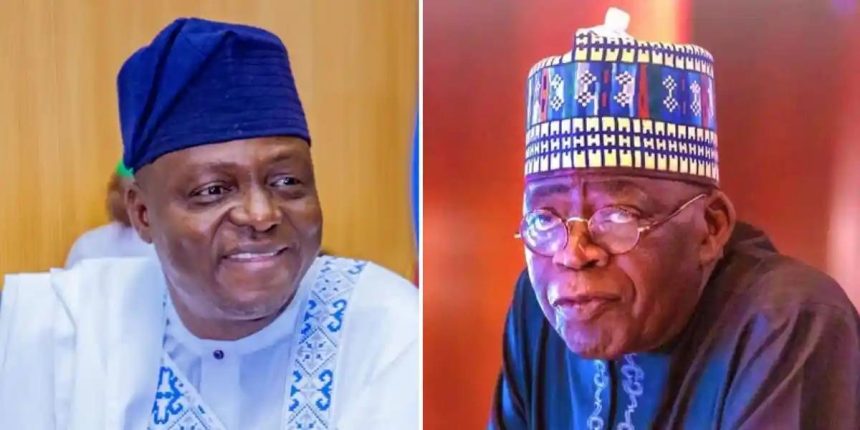
Professor Nentawe Goshwe Yilwatda, the National Chairman of the All Progressive Congress (APC), has praised the performance of the Renewed Hope Mandate administration of President Bola Ahmed Tinubu, saying the president was “building a trans-generational country with a prosperous economy, world class infrastructure, and good governance through aggressive provision of critical infrastructure round the country, and the $1trillion economy target.”
He said an honest assessment of Tinubu’s performance and legacy would acknowledge the fact that, “Future generations are going to be grateful for what Tinubu has done and history will definitely be kind to him.
More Read
“Tinubu will be remembered as a man who dared to clean the Augean table of our economy. He accomplished what others feared to do.”
He commended the president who he said deserved commendation “as a man on a rescue mission, who has successfully pulled our country out of bad governance and economic woods.”
Yilwatda who spoke exclusively to our correspondent in Abuja recently said, Governance is a serious business. It is not a joke. It is beyond politics. It requires vision, courage and patriotism and genuine leadership to deliver, which is exactly what Tinubu is doing for the country.”
More Read
The national chairman captured the concept of the Tinubu administration’s development matrix, saying, “What the Tinubu administration is doing in terms of provision of critical infrastructure all over the country is a wonderful economic strategy of interconnectivity, linking the entire country through road, rail and water transportation system.
“Mr. President is a man of great vision who has started laying a solid foundation for and a clear path for our country’s present and future prosperity among the comity of nations.
“He has set an ambitious target to ensure that the Nigerian economy attains one-trillion-dollar value by 2031. Now, how can you achieve such a high target? This is the question many Nigerians have been asking.”
According to him, “$1trillion economy cannot be achieved without provision of critical infrastructure that can carry such a massive economy. The current infrastructure can’t carry a one-trillion-dollar economy.
“It therefore requires huge investments in critical infrastructure in order to enhance nationwide economic and social connectivity.”
On deep sea ports
More Read
He said the present government was investing heavily in deep sea ports in order to boost imports and exports for the country.
He lamented that, “We do not have a single deep seaport. How can we be the giant of Africa and we can’t boast of a single deep sea port? And how can we increase the size of our economy without such critical infrastructure?”
He said it was as a result of this that the Tinubu administration started investing in building five deep seaports in Cross River, Rivers, Akwa Ibom, Ondo, and Lagos (Apapa) states.
Deep sea ports in Nigeria, according to him, “is so critical because it will reduce the costs of importation, which makes goods very expensive for Nigerians.
“Since we don’t have deep sea ports, big ships dock in other deep sea ports, dock at deep sea ports in other countries, and smaller barges transport the cargo into Nigeria, thereby transferring the cost of goods and services to our citizens.”
Yilwatda stressed that the deep sea ports would boost government’s revenue and reduce the costs of imports and exports, adding that, “This will further create thousands of new jobs for our citizens.
“This is one of the pillars of the economic reform of Mr. President that informs the numerous legacy infrastructures all over the country.”
On nationwide road network and railway
The APC chairman said further that the federal government under President Tinubu was building legacy highways and railway network, connecting the five deep sea ports.
He highlighted tha,”The coastal highway starts in Calabar and terminates in Lagos. Calabar Port will be connected to Akwa Ibom, Port Harcourt, Ondo and Lagos. From Calabar to the hinterlands, you have a dual carriageway that is the Trans-Sahara Super Highway that would transport goods into the hinterlands.
“The route runs from Calabar through Ebonyi, Enugu, Benue through Oweto and some parts of Kogi, to the Federal Capital Territory, and back to Keffi, Akwanga to Jos, to Bauchi, Gombe, Biu to Maiduguri.
“There is also the Lagos-Badagry-Benin Super Highway, which will serve the Lagos and Ondo ports, and connect with other major highways leading to Ibadan and beyond.
“Other dual carriageways will connect Minna to Abuja, Kogi to Abuja, and link the country’s major highway corridors, creating a nationwide road network. In addition, the rail network will run from Lagos to Abuja, Kaduna, Kano to Maradi in Niger Republic.
“The Nigerian government and the Nigerien government have signed a memorandum of understanding (MOU). Under the agreement, the Nigerian Customs Service will collect duties, while the Nigerian Immigration Service will check entries at Maradi port. Of course, there will be a dry port in Maradi.
“In other words, one of the economic benefits of this road project to Maradi is that it will enable goods to move directly from Nigerian coastal ports to Niger’s inland dry port.
“This means goods from Nigeria can get to the landlocked countries like Burkina Faso, Niger, Chad, and the Central African Republic through the Maradi cargo port, a transit trade hub for the landlocked countries. That is the essence of the roads and the rail networks.
“The Sokoto-Badagry Legacy Highway, for instance, comes with over 300 dams along the route. These dams will provide water for irrigation and cultivation. So, that corridor will be the food corridor of Nigeria.
“That will support agriculture, support water distribution for people, even for cattle along that route.
On gas /CNG
“The third key infrastructure is energy infrastructure, specifically, the Ajaokuta-Kaduna-Kano (AKK) Gas Pipeline, a 614-kilometer, $2.8 billion infrastructure project being undertaken by the Nigerian National Petroleum Company Limited (NNPC Ltd).
“The gas pipeline, which originated from Warri, will not just carry just gas alone; it will also carry fertiliser. That gas will be used for CNG buses. That same gas will go into homes.
“That same gas will power power plants. So, we are taking gas energy, not only to Northern Nigeria but to the whole country. Remember that Northern Nigeria is the food basket of the country.
“The rail and the road will enable food production, and the gas will enable us to process the produce, and then ship them (produce) back to the ports for export.
“These are the key economic infrastructure that this government is putting in place; the gas, the rail, the road, and energy.”
Besides that, he said under Tinubu, the huge investments by private players in the oil and gas sector has boosted the country’s standing as local production and supply have increased.
Apart from the Dangote Refinery, other refineries, he said, would soon begin operations thereby further easing the slight pressure on the local and international markets as a result of the Middle East crisis.
On fiscal reform
The national chairman of APC also underscored the significance of Tinubu’s fiscal reform that swept through the financial ecosystem of the country.
“Tinubu’s tax reform has created a more friendly order in our fiscal space. If you look at the tax reform, for instance, what he did was meant to establish equity in the system.
“Such a balance is needed for many reasons. For instance, it takes off many Nigerians who are earning less than one million from the tax net.
“It also exempts entrepreneurs who earn less than 100 million in turnover and are not allowed to pay tax.”
On Tinubu’s leadership
The APC national chairman also described President Tinubu as “a rare statesman, a passionate believer and promoter of Nigeria’s unity.”
He emphasised that contrary to negative perceptions, Tinubu had been uniting Nigeria with “unprecedented infrastructure project distributions, appointments, and political strategy across the regions and states of the country.
“Mr. President rescued the country from economic collapse via reform.”
Tinubu, he said, was not yet done: “Tinubu is not yet done with the business of fixing the country. There is still much he is doing, and he wants to continue to serve beyond next year, up to 2031, and Nigerians are still willing and ready to give him another chance.”
On economy: regaining balance and bouncing back
Current economic situation in the country, Yilwatda said, was a “necessary sacrifice” for tomorrow’s benefits.
“If not for the vision and courage of Mr. President, the country would have completely collapsed. The president promised Nigerians Renewed Hope Agenda, which is a comprehensive economic blueprint designed to revive and transform the Nigerian economy.
“You will agree with me that after the initial challenges, the economy has gained stability and growth is being stimulated. There is an ongoing massive investment.
“Massive infrastructure projects are going on across the country. We are now witnessing increased investments and production in different sectors of the economy.
“There are increased citizen empowerment programmes, fiscal discipline, among others. The reform was introduced by the president in order to change the way we were doing things that harmed the economy and Nigerians, especially the ordinary people.
“We were borrowing to eat and pay salaries in the name of subsidy, and we all thought that we were enjoying it. It was a near-total collapse before Mr. President came to the rescue by taking necessary but painful policy decisions that only he could have taken.
“I can’t say that enough: you need a brave heart like his to take the bull by the horns. He had to remove the unsustainable regime of fuel subsidy, reform our financial and fiscal policies, balancing the ripple effects with an expanded social safety net through numerous empowerment programmes.
“Gradually, the pains of the reform are being replaced by a sharp drop in inflation, especially in the agricultural sector with a boom, including increased exports.”
He said further that, “The exchange rate is stable now. Our children in the tertiary institutions can now go to school with less pressure of school fees on parents and guardians. The size of our economy is fast expanding after the rebase that placed us as the fourth-largest economy in Africa.
“We are witnessing huge impacts of emergent sectors such as the creative and entertainment sectors, solid minerals, fintechs, real estate, pension fund administration, the health sector, and so on under the Tinubu administration.
“These and other sectors are creating wealth and job opportunities for thousands of our energetic youths and people. In a nutshell, when you look at where the Tinubu administration stepped in and the decisive steps he has taken, especially the bold reforms that brought us to where we are today, you will notice a wide difference.
“This economic recovery, stability, and a growth process within three years is good news for the country. Before the next elections, Nigeria will witness more gains from the ongoing economic reform.”
The cerebral APC chairman also said the country’s financial institutions have been strengthened by firm monetary policies by the Central Bank of Nigeria (CBN).
Other sectors such as the solid minerals, fintechs, real estate, entertainment industries are witnessing unprecedented growth.