
By Idris Malunfashi
There is a particular moment in the life of every ambitious nation when political rhetoric must give way to the less glamorous business of reconstruction anchored on balancing the books, fixing institutions, building roads, expanding productive capacity, and creating the conditions under which private capital can flourish.
Singapore had that moment under Lee Kuan Yew. China confronted it under Deng Xiaoping. In Nigeria, an earlier generation led by figures such as Ahmadu Bello and Obafemi Awolowo understood a related truth that political power means little if it is not backed by roads, industries, institutions and the economic capacity to sustain a society.
President Bola Ahmed Tinubu is now attempting his own version of that difficult national reset.
The experiment is far from complete, and the triumphant verdict on his presidency will ultimately be determined by execution of projects and general performance rather than announcements.
More Read
Three years into the administration, the scale of the structural changes underway is difficult to ignore. The government has attacked some of the country’s longest-standing economic distortions, while simultaneously trying to expand infrastructure, domestic production, investment, and sub-national fiscal capacity.
That approach carries a heavy political price. The immediate consequences of reform have been painful for households and businesses; yet, the administration’s argument is that Nigeria cannot become a serious economic power while retaining systems that encourage waste, arbitrage, import dependence and fiscal indiscipline.
The emerging contest, therefore, is between the discomfort of restructuring and the opportunity to build a more durable economic order.
Fiscal reset
Tinubu’s defining economic decision came almost immediately after he assumed office, that is, the removal of the petrol subsidy.
For decades, the subsidy had been one of Nigeria’s most politically sensitive economic arrangements. It absorbed huge sums of public money, distorted the market and, critics argued, created opportunities for a narrow network of importers and beneficiaries to profit from a system whose cost was ultimately borne by Nigerians.
The administration chose not to preserve that arrangement. The decision was accompanied by another major intervention, which is the unification of the foreign-exchange market.
The multiple exchange-rate system had created an environment in which access to cheaper official dollars could generate extraordinary arbitrage opportunities, encouraging round-tripping instead of productive economic activity.
The immediate consequences were severe. The naira depreciated sharply, inflation accelerated and households faced a sudden increase in the cost of transportation, food and other essentials.
But the government maintained that these distortions could no longer be postponed without placing the entire economy at greater risk.
The fiscal numbers have since begun to tell another part of the story.
Tax collections rose from approximately ₦12.3 trillion in 2023 to ₦28.3 trillion in 2025, while more than ₦21.6 trillion had already been collected in the first half of 2026.
The expansion has been associated with the transition from the Federal Inland Revenue Service to the new Nigeria Revenue Service and with wider adoption of digital tax administration.
The government also tackled the foreign-exchange backlog, estimated at more than $7 billion, an obligation that had trapped the earnings of airlines, manufacturers and other investors inside Nigeria.
Clearing those liabilities was intended to restore confidence in the country’s financial system and reassure international businesses that revenues generated in Nigeria could once again be repatriated.
This is the less visible side of economic reform. It does not produce an immediate ribbon-cutting ceremony. It is the financial plumbing of a functioning economy.
And without that plumbing, the larger ambitions of infrastructure and industrialisation remain difficult to finance.
CBN’s monetary policy reform
The monetary authorities have been pursuing a parallel reconstruction.
Under Central Bank Governor, Olayemi Cardoso, the institution has moved away from the extensive use of so-called “Ways and Means” financing, through which the central bank had financed large government deficits.
The scale of the previous arrangement was enormous, with roughly ₦30 trillion in unbudgeted deficit financing having been accumulated and injected into the monetary system. The consequence was years of monetary expansion that contributed to inflationary pressure.
The Cardoso era has sought to restore conventional monetary instruments to the centre of policy: the Monetary Policy Rate, Cash Reserve Ratio, and Open Market Operations.
The transition has been painful, but there are reassuring signs of greater stability.
After reaching more than ₦1,800 to the dollar in 2024, the naira had settled around₦1,400 to the dollar by mid-2026. More significantly, the difference between the official and parallel-market rates, which had once been as wide as ₦305, had narrowed to approximately₦11.
Foreign-exchange reserves also climbed above $50 billion in March 2026, their highest level in thirteen years, compared with approximately $33 billion at the end of 2023.
The banking sector is undergoing its own strengthening through recapitalisation.
The larger objective is to move Nigerian finance away from speculative arbitrage and towards its traditional economic function, mobilising savings and providing capital to businesses capable of producing goods, and creating jobs and expanding the productive economy.
Roads and rail infrastructure
If monetary and fiscal reforms represent the invisible architecture of the economy, infrastructure is where that architecture becomes physical.
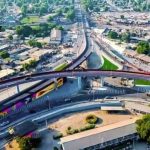
The 700-kilometre Lagos-Calabar Coastal Highway is the flagship. The project, according to the Minister of Works, David Umahi, was an idea Tinubu had conceived nearly three decades ago while serving as Lagos State governor. It is now being developed across several sections, with the ambition of connecting nine coastal states from Lagos to Cross River.
Its design also provides for a future railway corridor within the highway median.
More importantly, financing has moved the project beyond the realm of political aspiration. $747 million was secured for Section One in July 2025, followed by another $1.126 billion for Section Two in December 2025, the largest underwritten financing of its kind for a Nigerian road project.
The coastal highway is only one component of a much larger transportation programme.
The administration has also flagged off the Sokoto-Badagry Super Highway, the Akwanga-Maiduguri corridor and the Trans-Sahara Highway, while the president stated that more than 2,700 kilometres of highways were under simultaneous development nationwide by mid-2026.
The strategic logic is clear. The coastal corridor is intended to support the blue economy and strengthen connections along the Atlantic seaboard. The northern corridors are designed to link the Sahel-facing states more effectively with the rest of the federation and with regional trade routes.
Rail, meanwhile, has been incorporated into the physical design of the coastal highway itself.
The philosophy is not simply to build roads; it is to create economic corridors through which people, agricultural produce, manufactured goods, energy and capital can move more efficiently.
Local oil processing
Few developments capture Nigeria’s industrial contradiction more vividly than the country’s historic dependence on imported refined petroleum despite being a major crude-oil producer. That equation is changing.
The 650,000-barrels-per-day Dangote Refinery, supported by policy measures, including naira-denominated crude sales and licensing reforms, has transformed the country’s refining landscape. Its emergence has substantially reduced Nigeria’s dependence on imported fuel and positioned the country to become a significant exporter of petrol and aviation fuel.
The development is consequential beyond the refinery itself. For decades, Nigeria exported crude, imported refined products and spent scarce foreign exchange paying for the transformation of its own natural resource elsewhere.
Domestic refining breaks that cycle and creates opportunities for additional industrial activity around petrochemicals, logistics, storage, engineering and manufacturing.
Expansion of modular refineries
The Edo Refinery in Ikpoba-Okha has recorded capacity utilisation above 90 per cent. Waltersmith, in Imo State, has operated continuously since 2020 and has expansion plans that would take its capacity to 50,000 barrels per day. Aradel has emerged as the largest diesel producer among the modular-refinery operators.
Together, these developments demonstrate that the refining space once dominated by Nigeria’s largely moribund state-owned refineries is being reopened to private production.
That shift did not happen by accident. It reflects a deliberate policy attempt to replace import dependence with domestic productive capacity.
Agriculture and blue economy
Agriculture remains central to the question of whether economic reform will eventually improve living standards.
The administration said approximately 6,000 mechanised agricultural zones had been established across the country, alongside a government produce buy-back programme intended to give farmers greater market certainty, stabilise incomes and reduce post-harvest losses.
The ambition is significant because Nigeria’s agricultural challenge has never been simply about how much land is available; it is about productivity, mechanisation, storage, transportation, markets and the ability of farmers to earn predictable returns.
The government has also created a new economic frontier. In 2023, Nigeria established a dedicated Ministry of Marine and Blue Economy, the first of its kind in the country’s history.
Its creation formalised an attempt to treat shipping, fisheries, ocean energy, and maritime tourism as interconnected economic opportunities.
The Lagos-Calabar Coastal Highway fits directly into this strategy. But this is also an area where the administration’s ambition is ahead of the evidence.
Capital allocations to the ministry have so far been modest compared with the scale of the vision. Turning Nigeria’s coastline into a genuine blue-economy engine will require substantial investment in dredging, port depth, and fisheries infrastructure and related maritime facilities.
The opportunity is enormous. The work required to realise it is only beginning.
Boost in solid mineral sector
Nigeria’s solid-minerals sector is receiving a different kind of policy attention.
Under the Minister of Solid Minerals Development, Dele Alake, the government has pursued a more controlled licensing regime, with emphasis on ensuring that mining licences are connected to domestic processing rather than simply exporting unprocessed minerals.
The principle is straightforward: Nigeria should not export raw mineral wealth and then buy back finished products at many times the original value.
The financial indicators point to an expanding sector. Solid-minerals revenue rose from approximately ₦16 billion before the reforms to more than ₦70 billion in 2025.
The sector has also attracted approximately $800 million in foreign investment connected to gold, lithium and industrial minerals, with a further $402.7 million reported across lithium, gold and limestone projects in a single recent year.
The president has repeatedly framed the issue in strategic terms, particularly around lithium and battery manufacturing.
The objective is not simply to become a major exporter of mineral ore. It is to capture more of the value chain – from extraction to processing and, eventually, manufacturing.
That is the difference between an extractive economy and an industrial economy.
New investments in oil and gas corridor
Nigeria’s hydrocarbons sector is also showing signs of renewed investor interest.
Fiscal incentives approved in early 2026 helped pave the way for Shell’s Final Investment Decision on the Bonga Southwest Aparodeepwater project, a development expected to attract close to $20 billion in investment by itself.
In late 2025, the Nigerian Upstream Petroleum Regulatory Commission (NUPRC) also approved oil-field development plans estimated at approximately $20 billion.
Tinubu has projected that Nigeria could attract nearly $20 billion in total foreign direct investment in 2026, attributing the anticipated increase to the removal of regulatory bottlenecks and the greater credibility generated by foreign-exchange reform.
The capital-importation figures provide a striking comparison: inflows increased from only $3.9 billion in 2023 to $23.22 billion in 2025.
The broader message is that investors respond, not merely to Nigeria’s resource endowment but to the predictability of the rules governing access to those resources.
Recent moves have continued in that direction. In August 2026, the government approved a new deep-water oil and gas investment framework aimed at unlocking as much as $50 billion in potential investment.
The task is now to ensure that renewed interest in oil and gas is converted into wider industrial capacity rather than another cycle of dependence on crude exports.
New deep sea ports
Nigeria’s maritime position gives it another strategic asset. The country’s ports have traditionally handled more than 90 per cent of national cargo by volume.
The administration is now seeking to position them as instruments for regional trade, particularly as the African Continental Free Trade Area (AfCTA) expands.
The government’s maritime programme includes a $1 billion memorandum for the rehabilitation of the Lagos Port Complex and Tin Can Island, digitalisation through the Port Community System and National Single Window, and continued development of the Lekki Deep Sea Port.
The early indicators have been striking. Port tonnage increased by 19.5 per cent in the first quarter of 2026, while transshipment-container activity rose 83 per cent. At one point, Lekki Deep Sea Port recorded a throughput increase of more than 2,000 per cent year-on-year.
Other deep-sea ports have also been approved for development beyond the traditional Lagos concentration.
The government sees this as part of a wider $27 billion regional maritime investment wave, with Nigeria seeking to establish itself as the principal gateway rather than allowing neighbouring economies to capture that opportunity.
For a country with Nigeria’s population, industrial base and geographic position, efficient ports could become one of its most powerful competitive advantages.
State govts’ fiscal buoyancy
Since May 2023, more than ₦56 trillion has been distributed to the three tiers of government through the Federation Account Allocation Committee (FAAC).
The figure represents roughly 35 per cent of all funds distributed through FAAC since 1999, despite being accumulated in less than one-third of that period.
The implications are profound. The federal government has effectively transferred a much larger volume of resources to states and local governments. But has the large volume of trillions transferred to the state by the president been converted to roads, schools, hospitals, water systems, jobs and productive infrastructure?
In other words, Abuja’s reform has created a new accountability test for the sub-national governments.
The question is no longer only about what the federal government is doing with national resources. It is what each state is doing with its enlarged fiscal space.
The Tinubu legacy question
Three years into the administration, Nigeria’s economic story is, therefore, more complicated and more consequential than either its supporters or its critics sometimes admit.
The country has moved away from a heavily subsidised petroleum regime. It has dismantled the old multiple-exchange-rate architecture. The central bank has returned to more orthodox monetary tools. Foreign-exchange reserves have strengthened.
The tax system is generating considerably more revenue. Foreign-exchange obligations have been cleared. Banks are being recapitalised.
At the same time, Nigeria is attempting to build an interconnected network of roads and rail, expand refining, mechanise agriculture, reinforcing blue-economy, process its mineral resources locally, attract major oil and gas investment, and reposition its ports for continental trade.
These are not isolated initiatives. They form the outlines of a new economic model: one less dependent on subsidies and raw imports, more capable of mobilising domestic revenue, more attractive to private investment and increasingly oriented towards production.
The risk is that Nigeria has been here before. The country has a long history of grand plans that failed because implementation fell behind ambition. Projects were announced but not completed. Institutions were created but not strengthened. Capital was committed but poorly managed. Reform was begun and then abandoned when political pressure became intense.
That is why the next three years may matter more than the first three. The administration has built the foundation of a new economic order. The next challenge is to make that order visible in the lives of ordinary Nigerians, which is also being proactively addressed through different empowerment programmes, job creations, among others.
The question that will determine Tinubu’s historical standing is therefore brutally simple: did the pain produce a better economy? And the answer is brutally yes!
If the answer, over time, is yes – if inflation falls sustainably, purchasing power recovers, infrastructure begins to reduce logistics costs, factories expand, exports rise, jobs multiply and private capital continues to enter the country – Tinubu may eventually be remembered, not merely as the president who imposed difficult reforms, but as the leader who altered the structure of Nigeria’s economy for the best.
The subsidy era has been dismantled. The currency regime has been reconfigured. Fiscal mobilisation is expanding. Infrastructure spending is accelerating. Domestic refining is altering the country’s energy equation. New ports, minerals, agriculture and the blue economy are being repositioned as growth engines.
States are receiving unprecedented fiscal flows. Foreign investors are beginning to reassess Nigeria. The direction, therefore, is no longer the principal uncertainty.
This is the defining legacy Tinubu. It is not in the scale of the reforms announced, but it is in the architecture that supports the weight of the Nigeria that citizens have long been promised.