
By Nnamdi Chinedu and Juliana Bitrus
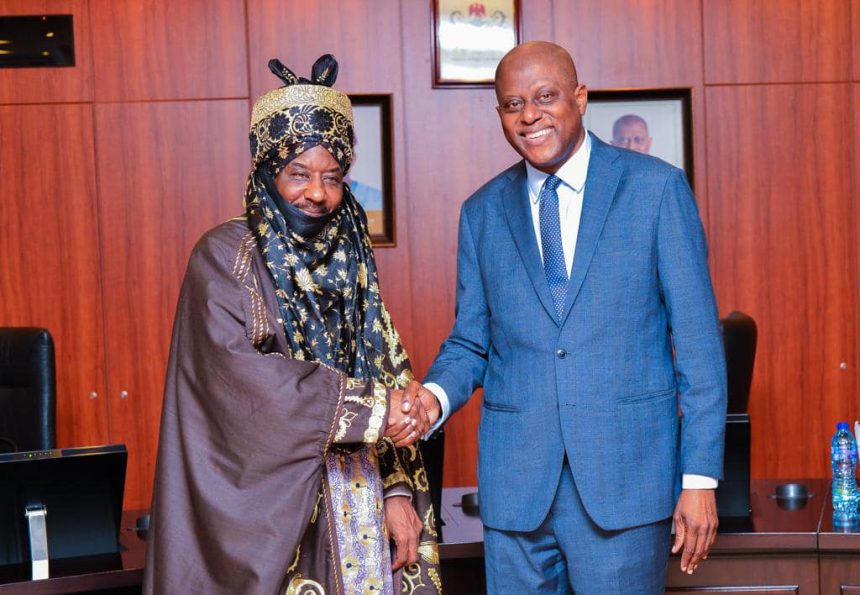
When the Emir of Kano, Muhammadu Sanusi II, said during an interview on News Central Television, that Nigeria’s economy is, for the first time, growing faster than its population, he was not merely offering a sound bite.
He was delivering a verdict from a former Central Bank of Nigeria (CBN) governor, Olayemi Michael Cardoso, on three years of monetary reforms that have taken the country from the brink of macroeconomic collapse to a season of cautious, and contested stability.
“I have nothing but positive words for what the Central Bank has done. We are coming from the background of a very high level of instability as a result of loose money and uncontrolled growth in money supply.
“The Central Bank has taken one year to mop up all that money,” Sanusi said, describing an economy he argued had pulled back from “the brink of total economic collapse.”
More Read
His acknowledgement that inflation and high interest rates remained major challenges for businesses and households notwithstanding.
His comments which quickly went viral arrived days after the Monetary Policy Committee (MPC) held the benchmark interest rate steady for a second consecutive meeting.
His comment reignited debate over what role monetary policy has actually played in Nigeria’s recovery, and how much credit it deserves.
Verdict from ex-CBN boss
Sanusi’s remarks carry particular weight because he once sat where Cardoso now sits. As CBN governor between 2009 and 2014, he built a reputation as a reformist unafraid to name uncomfortable truths about Nigeria’s fiscal and banking architecture.
His endorsement of Cardoso’s tightening cycle, therefore, reads less like a courtesy and more like a professional assessment.
At the heart of his argument is a straightforward monetary story. It is the fact that the CBN inherited an economy flooded with liquidity, much of it created through unchecked financing of government deficits, and it has spent roughly the past three years withdrawing that liquidity from the system.
The consequence, in Sanusi’s telling, is an economy finally growing at a pace that outstrips population growth, a threshold Nigeria had not crossed in years, given population expansion of roughly 2.4 per cent annually against GDP growth that had, for a long time, lagged behind it.
Three-stage playbook
Cardoso’s tenure has broadly moved through three identifiable phases, each aligning with distinct planks of monetary policy.
He moved for recovery, arresting the exchange rate collapse and inflationary spiral inherited in 2023.
This phase featured the unification of the multiple exchange rate windows, the clearing of a verified forex forward backlog exceeding $7billion, and the introduction of the Nigeria Foreign Exchange Code to enforce ethical trading standards among market participants.
Stabilisation
This is anchored on aggressive monetary tightening. The Monetary Policy Rate (MPR) was raised repeatedly before being held, most recently, at 26.50 per cent for a second straight MPC meeting.
The CBN had defended this level as necessary to keep real interest rates positive against still-elevated inflation.
Consolidation
The third, now underway, is consolidation into growth. This is where the CBN has begun signaling openness to eventual easing, contingent on inflation continuing its downward trajectory, while emphasising that stability remains the platform, not the destination, for broader economic expansion.
Positive indicators
Several data point underpin the more upbeat assessments of the economy’s trajectory.
Headline inflation, which peaked above 24 per cent in the aftermath of the 2023 subsidy removal and forex reforms, has moderated steadily. The National Bureau of Statistics (NBS) recorded headline inflation at 15.91per cent in June 2026, down marginally from 15.93 per cent in May, with core inflation easing to 15.92 per cent.
Currency stability: The naira has traded within a comparatively narrow band through 2026, closing recently around N1,358/$ at the Nigerian Foreign Exchange Market (NFEM).
This is supported by what the CBN described as a spread of under two per cent between official and parallel market rates, a dramatic compression from the double-digit gaps that characterised the pre-reform era.
External reserves: Gross external reserves rose above $52.5billion by mid-July 2026 and touched $52.19 billion by mid-August, the highest level in 17 years, according to CBN data cited by Governor Cardoso’s office.
The Bank has attributed the accretion to sustained FX inflows, stronger diaspora remittance channels – which it says have tripled from roughly $200 million to $600 million monthly since the reforms began – and renewed investor confidence.
The end of Ways and Means financing: Perhaps, the reform most central to Sanusi’s argument is the near-total winding down of Ways and Means advances, the overdraft facility through which the CBN had financed federal government deficits, often far beyond the statutory cap of five per cent of the previous year’s revenue.
That facility ballooned to N26.95 trillion by May 2023. Cardoso told the 2026 Monetary Policy Forum that it had since been reduced to N2.84 trillion as of January 2026, a decline he called “one of the sharpest fiscal consolidations in recent history.”
The Bank has also halted more than N10trillion in quasi-fiscal interventions previously disguised as development finance, measures Cardoso said had ‘contributed to an increase in money supply, raising prices to the level of inflation we are grappling with today.”
Institutional applauses
International and domestic assessments have broadly corroborated the direction of travel, even where they diverge on pace and durability.
Fitch Ratings has upgraded Nigeria’s Long-Term Foreign-Currency Issuer Default Rating twice in roughly two years, moving it from ‘B-‘ to ‘B’ with a stable outlook, citing “increased confidence in the government’s broad commitment to policy reforms.”
This has spanned exchange rate liberalisation, monetary tightening and the end of deficit monetisation. S&P Global Ratings followed with a similar upgrade to ‘B’, pointing to stronger external reserves – which it put at roughly $50 billion as of March 2026, against about $33 billion in 2023 – and projecting inflation would ease to 17.7 per cent in 2026 with real GDP growth settling near 3.7 per cent.
The World Bank has offered a more layered picture. Its April 2026 Nigeria Development Update projected GDP growth of about 4.1 to 4.2 per cent for 2026, with inflation easing to roughly 14.9 per cent by year-end, crediting “more stable macroeconomic conditions and a gradual recovery in investment.”
But the same institution reported that the national poverty rate climbed to 63 per cent in 2025 – roughly 140 million people – even as inflation began to ease, a finding it said exposed “a disconnect between moderating prices and real income growth.”
Cautionary notes
World Bank Nigeria lead economist, Fiseha Haile, cautioned that while business activity remains resilient, authorities should save windfalls from higher oil prices and keep monetary policy tight rather than declare victory prematurely.
PwC Nigeria’s Economic Outlook 2026 struck a similarly two-sided note. Sam Ado, the firm’s Regional Senior Partner for West Africa, told a Lagos roundtable that disciplined monetary policy had produced “a degree of stability many once thought impossible,” but warned that “stability is not victory. It is only a platform on which sustainable growth must be built.”
PwC’s Chief Economist for the region, Olusegun Zaccheaus, added that interest rates were unlikely to fall sharply in the near term despite easing inflation, citing lingering liquidity concerns tied to the 2027 election cycle. He also said consumer recovery would continue to lag broader macroeconomic gains.
The Director-General of the World Trade Organisation (WTO), Ngozi Okonjo-Iweala, speaking at the 7th Africa Emerging Markets Forum in Abuja, praised the CBN’s monetary reforms but framed her endorsement conditionally.
“Nigeria needs to continue the work on overall macroeconomic reforms with a careful approach to fiscal issues, contracting of debt, and debt management,” she said.
According to her, citizens must “feel the dividends of reform in the real economy.” In a separate engagement with Cardoso, she went further, arguing that Nigeria’s ultimate economic trajectory would hinge less on natural resources than on leadership quality and implementation.
“Leaders who ask the right questions, focus on implementation, create jobs for young people and remove the obstacles preventing economic growth,” she said.
Sanusi is right
Taken together, the evidence lends support to Sanusi’s central claim. Nigeria’s GDP growth, estimated at around 4.2 per cent for 2025 and projected near 4.1 to 4.4 per cent for 2026 by the World Bank and IMF, does now outpace the country’s population growth rate of roughly 2.4 per cent – a genuine, if narrow, threshold crossing that would not have been credible amid the currency chaos and inflationary spikes of 2023 and 2024.
The CBN’s disciplined exit from deficit monetisation, its currency unification, and its reserve accretion represent the recovery and stabilisation stages largely completed.